
Splitting bills as a couple sounds simple until someone asks, "Hang on — who paid for what this month?" Between the rent, the food shop, meals out and the holiday you're still paying off, two people's money gets tangled fast. And that lack of clarity is one of the quietest causes of arguments about money.
This guide covers what usually counts as a shared cost, the three most common ways to split it, and a worked example so you can compare them. At the end, how to set it all up in Bee Balance.
Why money gets complicated for two
The real problem is rarely the money itself. It's not having one shared record. When each of you keeps track in your head, three things tend to happen.
- Costs get forgotten. One of you did the big shop, the other paid the electricity, and by the end of the month neither of you remembers the numbers.
- Imbalances go unnoticed. With nowhere to add things up, one person can end up paying more without either of you realising.
- Conversations get put off. Money talk is awkward enough; without the figures in front of you, it gets postponed until it turns into a row.
A shared record doesn't replace the conversation, but it makes it much easier: "I think I've paid more" becomes "here it is".
What counts as a shared cost
Rent or mortgage, groceries and household bills — energy, water, broadband — are almost always shared. The grey areas are everything else: one person's gym, presents for the other's family, a subscription only one of you uses, the car only one of you drives. It's worth making the list together, writing down where each item sits, and coming back to it whenever something new turns up.
Three ways to split bills as a couple
There's no single right method — only the one you both think is fair and can stick to month after month. Three approaches cover almost every couple.
1. Straight 50/50
Every shared cost is split down the middle, whoever happens to pay at the till. It's the simplest method and works well when you earn similar amounts. When you don't, it weighs much more heavily on whoever earns less — the example below shows by how much.
2. In proportion to income
Whoever earns more pays more. To find the ratio, divide each person's take-home pay by your combined take-home pay: if one of you brings in 60% of the household income, they cover 60% of the shared costs. It's the fairest option when there's a real pay gap, because you each put in the same share of what you earn.
3. Yours, mine and ours
Each of you pays an agreed amount into a joint account every month, and the rent, food shop and household bills come out of it. Whatever's left stays in your own accounts, to spend as you like.
The amount you each pay in can follow either of the methods above — 50/50 or proportional. The difference is in day-to-day life: shared costs all come out of one account, so "who paid for what" stops being a question and there's nothing to settle at the end of the month. And you each keep your independence, without having to justify a coffee or a new book.
It's one of the most popular set-ups for good reason: openness about what's shared, freedom over what's yours.
A worked example
Example
- Emma takes home
- €2,200
- Tom takes home
- €1,300
- Shared costs
- €1,400
The shared costs are rent (€900), groceries (€350) and household bills (€150). All figures are monthly, after tax.
| Emma | Tom | |
|---|---|---|
| 50/50: each pays | €700 | €700 |
| … as a share of income | 32% | 54% |
| Proportional (63% / 37%): each pays | €880 | €520 |
| … as a share of income | 40% | 40% |
Split 50/50, Tom hands over more than half his pay to shared costs and is left with €600 for everything else, while Emma keeps €1,500. Split proportionally, both put in the same 40%, leaving Emma €1,320 and Tom €780.
What the example shows: when your incomes are close, 50/50 is simple and fair. When the gap is as wide as Emma and Tom's, it stops being balanced: a proportional split asks the same effort of both of you, and that's usually what feels fair.
With a joint account, whichever you choose becomes a single transfer at the start of each month — in the proportional case, €880 from Emma and €520 from Tom. The rent, the food shop and the bills all come out of that.
Managing shared costs in Bee Balance
Bee Balance doesn't settle up between the two of you — it shows where your shared money goes, month by month. That makes it a natural fit for the joint-account approach: one wallet just for the household, kept apart from your own finances.
Create a wallet for the two of you
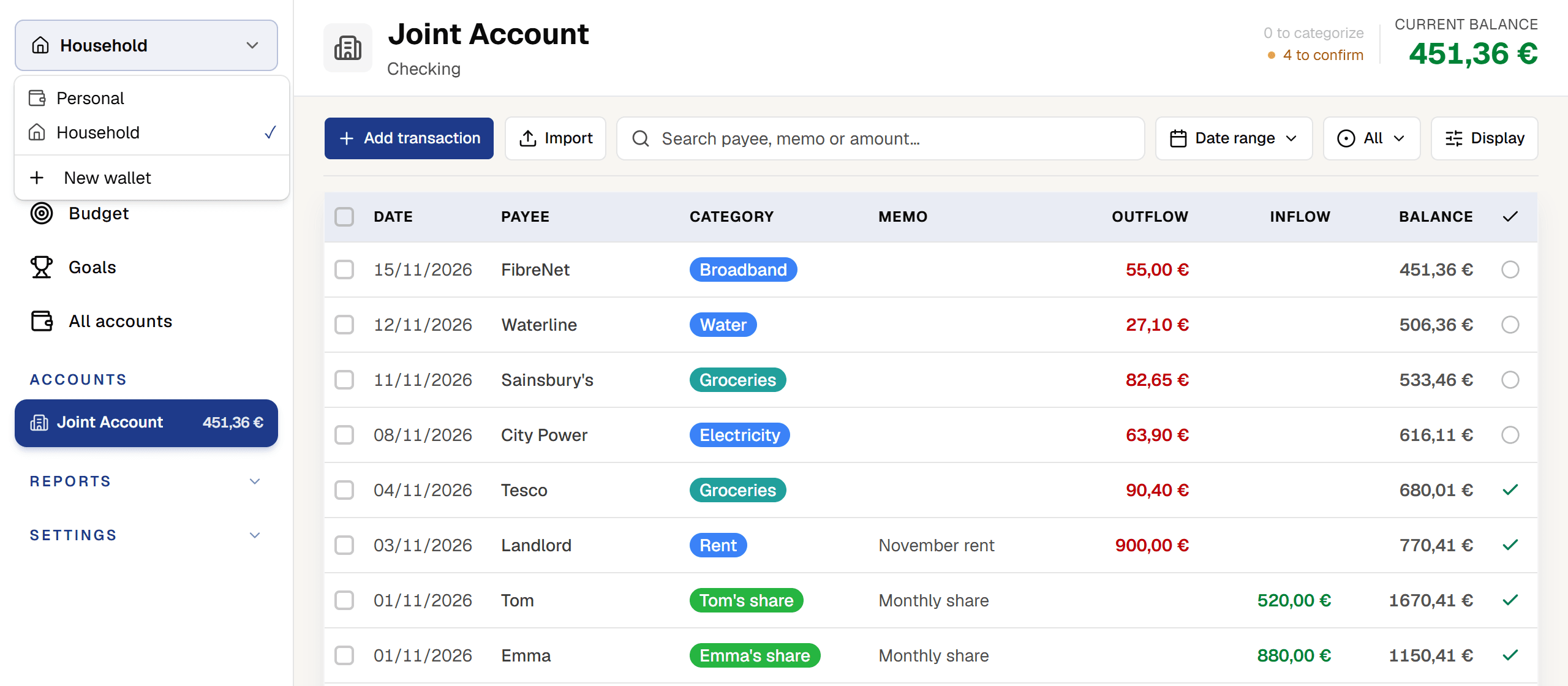
In the wallet switcher at the top of the menu, choose New wallet and call it something like "Household". Your joint account lives inside it. Your personal finances stay in a separate wallet, so one person's morning coffee never gets mixed up with the rent you share.
Bring in your joint account
In the joint account, go to Import › Import by paste: copy the transactions from your bank's website and paste them in. Each person's payment comes in as their share, and the spending lands in its categories — over time, Bee Balance learns to categorise your regular payees on its own. Watch Smart Paste.
Set a budget for shared costs
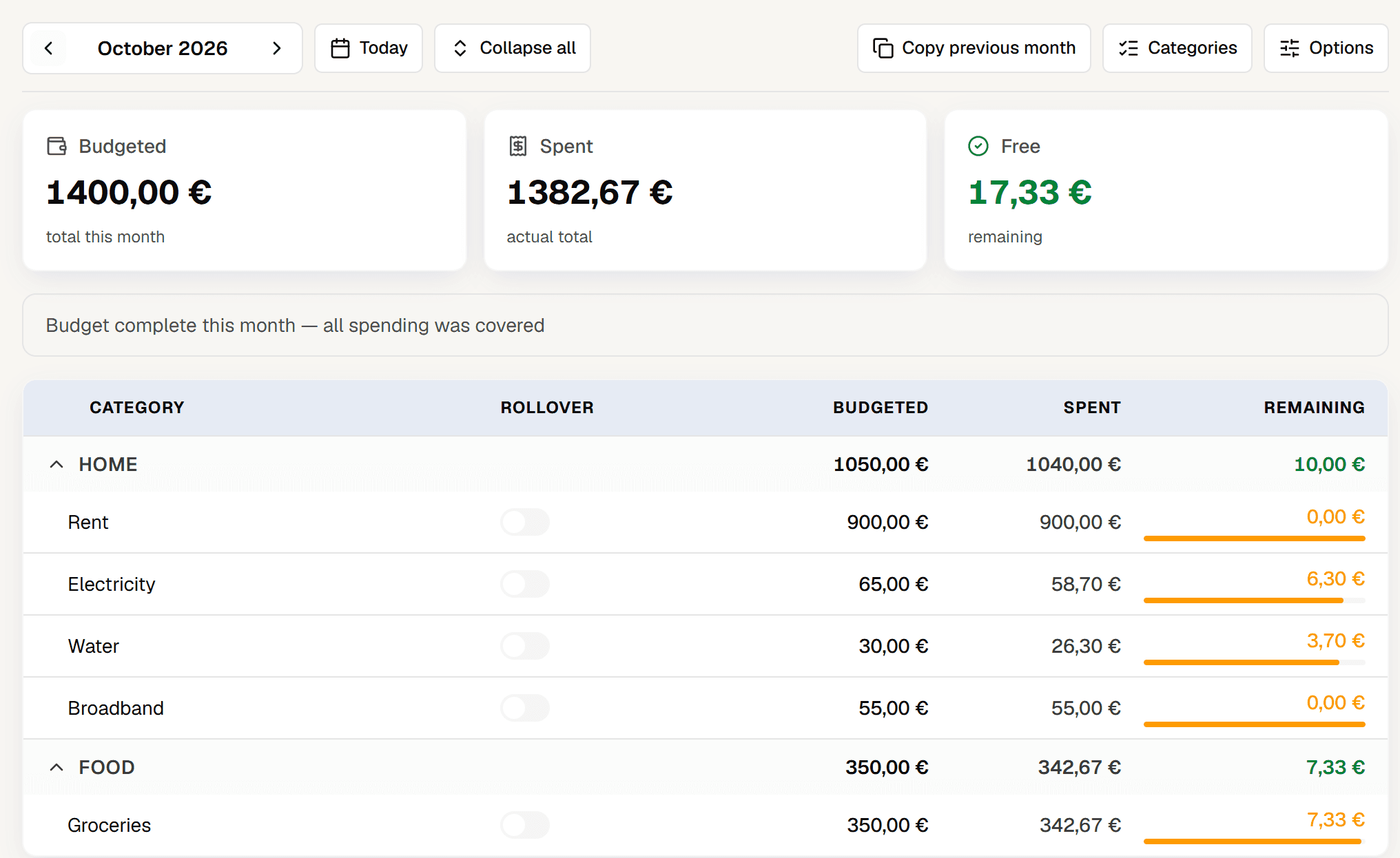
In the wallet's Budget, give each shared cost the amount you agreed: rent, groceries, electricity, water, broadband. The total should match what you pay in between you each month.
Review the month together
At the end of the month, the Budget shows how much went on each shared cost next to what you'd planned. If the food shop keeps running over, that's your cue to adjust what you each pay in — based on the figures, not on a hunch.
Habits that make it stick
What separates a couple who stay on top of their money from one who gives up in week three is habit, not the app.
- A regular money check-in. Ten minutes a week, or a coffee at the start of the month, is enough to spot what didn't go to plan.
- Start simple. Five or six shared categories are plenty; you can fine-tune later.
- Don't use the numbers as ammunition. The point is to avoid surprises, not to keep score.
With a method you both agree on and one shared record, the conversation stops being about who paid more and starts being about what you're saving for together.
To decide how much of your money goes where, the 50/30/20 rule is a good place to start.
Frequently asked questions
What's the fairest way to split bills as a couple?
The one you both think is fair and can keep up. Three questions help you choose: are your incomes similar or very different? Do you each want money of your own? How much effort are you willing to put into settling up? Whatever you pick, keep everything in one place.
How do you split bills in proportion to income?
Divide each person's take-home pay by your combined take-home pay. If one of you earns €2,200 and the other €1,300, that's 63% and 37%, and every shared cost is split in that ratio.
Joint account or separate accounts?
Plenty of couples do both: a joint account for shared costs and their own accounts for everything else. That way, who paid for what stops being a question — the shared bills all come out of the same account.
Does Bee Balance work out who owes whom?
No. Bee Balance doesn't settle up between people; it shows where your shared money goes, month by month. That's why it fits the joint-account approach best: each of you pays in your share, and there's nothing left to settle.
How often should we review the split?
Whenever something big changes — a pay rise, a move, a baby — and at least once a year.
Does this only work for couples?
No. A separate wallet works just as well for costs shared with housemates or family, or for keeping personal and business spending apart.