
The 50/30/20 rule is one of the simplest ways to budget. Take what you bring home each month and split it three ways: half for the things you can't avoid, almost a third for the things you choose, and a fifth for your future self.
It was popularised by Elizabeth Warren and Amelia Warren Tyagi in their book All Your Worth, and it has lasted because it asks so little. There's no need to track every coffee or plan to the cent. You only need to know which of the three buckets each expense belongs to — and, at the end of the month, whether the proportions held.
What goes where
- 50% — Needs. Rent or mortgage, groceries, energy and water, getting to work, essential insurance, healthcare, and the minimum payment on any debt.
- 30% — Wants. Eating out, takeaways, holidays, clothes you don't strictly need, the gym, streaming subscriptions — anything you could cut without the month falling apart.
- 20% — Savings. An emergency fund, medium-term goals, your pension, and paying off debt faster than the minimum.
The line between a need and a want isn't always sharp. Groceries are a need; the good bottle of wine on the same receipt is a want. Don't split hairs: what matters is that each category lands on the same side most of the time.
A worked example
With a take-home pay of €1,800 a month, the targets look like this:
Example
- Needs · 50%
- €900
- Wants · 30%
- €540
- Savings · 20%
- €360
Now a real month: rent of €700, groceries of €250, bills of €100 and €50 on transport.
| Target | Real month | |
|---|---|---|
| Needs | €900 | €1,100 (61%) |
| Wants | €540 | €450 (25%) |
| Savings | €360 | €250 (14%) |
What the example shows: the rule isn't a test you pass or fail; it's a reference point. Here it shows that the pressure comes from housing, not from eating out — which is exactly where to look first.
When the numbers don't fit
In many cities, rent alone pushes needs past 50%. When that happens, bend the rule rather than drop it: 60/20/20 works, and so does 70/10/20 for a tighter stretch. What matters is that savings get a fixed share up front instead of being whatever is left at the end of the month.
Budgeting as a couple? Start with how to split bills as a couple.
Setting up the 50/30/20 rule in Bee Balance
In Bee Balance you don't need extra groups or a separate spreadsheet. You tag each budget category as a need or a want, and the app works out the three buckets from there. It takes four steps, and you only do them once.
Turn on classification in your budget
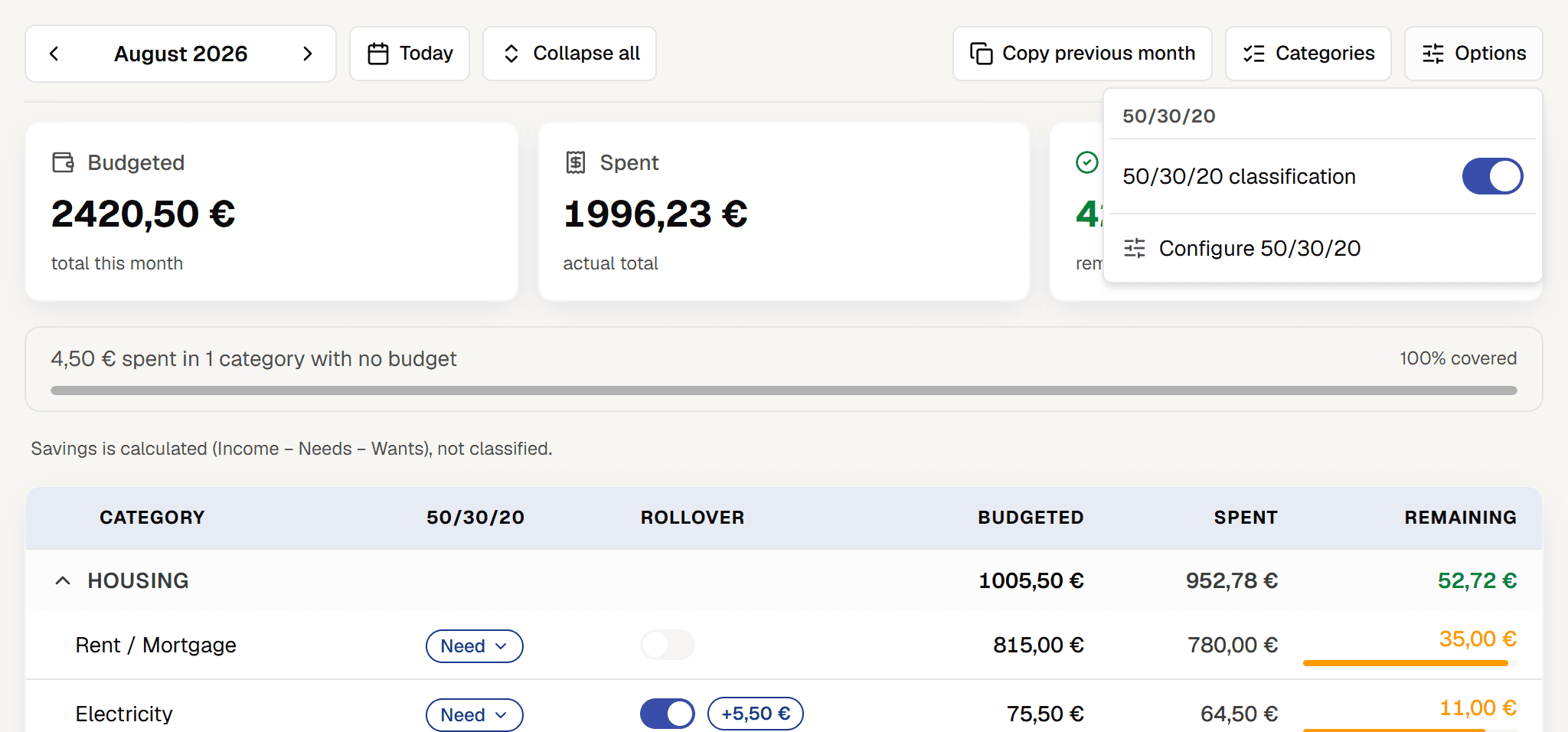
On the Budget screen, open Options and switch on 50/30/20 classification. A new 50/30/20 column appears next to each category.
Tag each category
In the new column, set each category to Need, Want or Not relevant. Savings and investment categories — an emergency fund, a pension — are Not relevant: savings aren't tagged, they're what's left of income after needs and wants.
Until every category is tagged, the Budget screen shows how many are left.
Set your targets and income sources
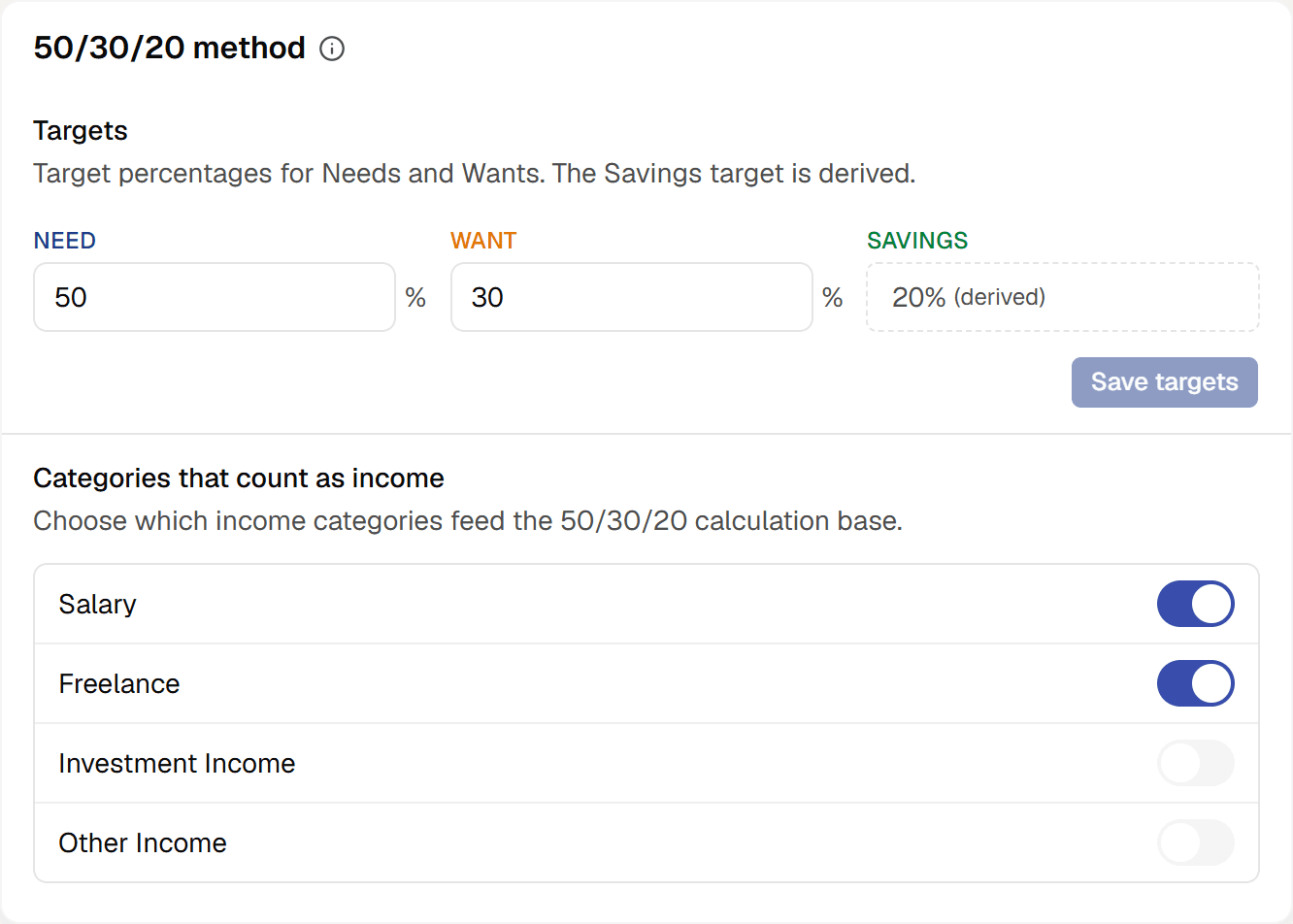
Under Options › Configure 50/30/20, set the percentages for needs and wants; savings make up the rest to 100%. This is where 50/30/20 becomes 60/20/20 if that suits you better.
On the same page, choose which income categories count towards the calculation — your salary, say, but not a one-off refund.
See your month in three buckets
In the Budget vs Actual report, switch on Include 50/30/20 method. You'll see how much went on needs, wants and savings that month, side by side with your targets.
Frequently asked questions
Is the 50/30/20 rule based on gross or net income?
Net. It starts from what actually lands in your account after tax and deductions — your take-home pay.
Where do loan repayments go?
The minimum repayment is a need. Anything you pay off on top of that counts as savings.
What if I can't save 20%?
Start lower, but fix the number. Saving 5% every month builds the habit; the percentage can grow later.
Where do savings categories like an emergency fund go?
In Bee Balance, mark them as Not relevant. Savings aren't classified: they're worked out as income minus needs and wants, so whatever goes into your emergency fund is already counted.